Tuesday, 8 January 2013

Reevaluating my views: Feminism

Looking back over old blog posts, one thing I've realised is that my views on feminism have changed somewhat in the last year. While I feel that the "glass ceiling" debate is no less important than it once was, and that women should certainly be able and encouraged to achieve the same high-ranking professions as men, it is far from being at the crux of my passion for feminism. Perhaps this is because the world in which I now exist is different from the world I existed in a year ago: I can scarcely call myself a "recent graduate", and when you consider that most "recent graduates" in these desolate times find themselves exploiting their newly-acquired wealth of knowledge behind the counter of their local McDonald's, a career in the boardroom is hardly on the cards for me. Male or female (but still largely male), a career in the boardroom now tends to be reserved solely for former private school students and Oxbridge graduates... But that's a different argument entirely.

I recall, seven-and-a-half years ago, uttering that sentence opening that now causes me to (metaphorically) bang my head against the wall in frustration: "I'm not a feminist, but..."
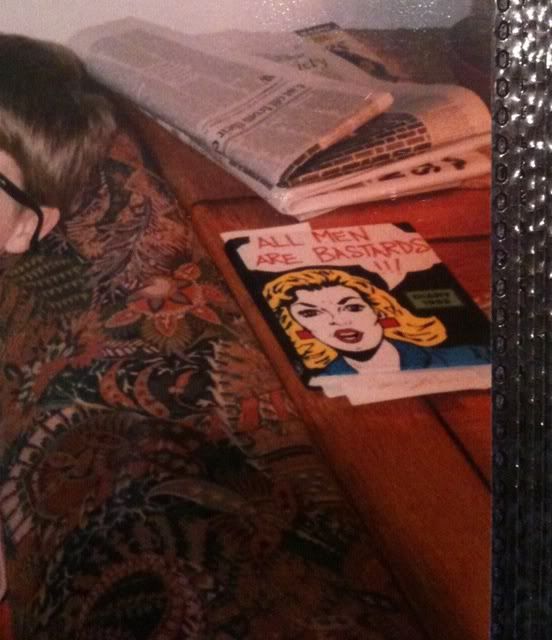

I grew up on the Spice Girls, with a mother who had a kind of montage of feminist postcards framed and pinned up in the hallway, and who left her diary (pictured above) lying around the flat for impressionable girls' eyes to fall upon. I threw out peace signs like it was Christmas and challenged the boys in the school playground to races (I was a freakishly fast runner... y'know, for a girl). I pulled people up on their casually sexist remarks from the age of seven, and I knew that I was just as smart and just as capable as any boy. And yet, feminism was a bad word. To be a feminist was to be angry, hairy and wear dungarees.

It took going out into the world and seeing the injustices women face (and that I would now invariably face) with my own eyes to change my mind. It took being pushed and shoved on buses and tubes because I am smaller than 50% of the population and therefore less likely to start a fight; it took, not just being sexually harassed more times than I can count, but becoming so accustomed to sexual harassment that I began to expect it, and then barely think twice about it when it happened again; it took being criticised for taking an interest in football instead of fashion; it took finding myself growing up awkward and imperfect whilst being held up against impossibly perfect images of women and being told that I am not good enough if I am not like them; it took being 15-years-old, haemorrhaging my way through the worst period I have ever known, and being told by a (male) doctor that I must be having a miscarriage, there was no other explanation for it, in spite of the fact that I had told him repeatedly that I was a virgin; it took being used and exploited by men, or being treated as something fragile instead of something strong. It took expanding my mind and allowing myself to be unafraid of stigma to accept that, yes, my thoughts and my views and my attitudes make me a feminist, whether I choose to shave my legs or not. I am happy now to admit that I was wrong, just as I am happy now to admit that I was misguided a year ago. Feminism is much bigger than I thought it was.

Every woman (and man) will have their own individual relationship with feminism, whether they recognise it or not, but we have to see past our own relationships if we are going to get anywhere. For some, for the more privileged, that relationship will be "Can I make it to the top?" Will society ever stop assuming that "doctor" is male unless "female doctor" is specified, or that "nurse" is female unless "male nurse... I wonder if he's gay??" is specified. I might be one of the more privileged, because for me, I often find myself wondering if I will be one of the illustrious 17% of playwrights who happen to be female this year, and I get arsey when people address me by the title "Miss" instead of "Ms". Lucky me to have such a concern, I guess.

For others, the corcerns will be "How can I afford to have a child when I can barely afford to live myself?" and "I am being assaulted every day in my own home." For the majority of us, rape is something we fear when we are walking home late at night on our own, and the messed-up world in which we live tries to tell us that we are somehow more vulnerable, or somehow more at fault, if we are dressed in a certain way, and that perhaps if we hadn't gone down that alleyway, we might have been able to prevent it. For others, rape is something to be feared when we wake up in the morning or go home in the evening. It is not just a fear; it is a guarantee, and an unbreakable cycle. Conviction rates are still pathetically low.

Feminism for some is the right we in Western society have come to accept as our most basic: the right to healthcare, the right to our own bodies. If we want an abortion and if the pregnancy is early enough, we can have one; we have access to contraception, and whether practice is the same as principle, we can refuse sex if we do not want it; we do not lose "value" at the loss of our virginity and we are not told to marry against our own will. This is a reality for some that we are guilty of turning a blind eye to in favour of the "glass ceiling", and just as the more privileged feminists try to convince men that feminism benefits them too, we must also remind ourselves that feminism is working to free more than just the white, more than just the middle and upper classes, more than just your mother or your daughter or sister or niece.

Feminists, if we want to free ourselves, we must also free our sisters.

Saturday, 5 January 2013

Poetry: Man

Man

Man, you do not make me.
You may spread your seed like a dandelion weed,
but you do not hold me, grip me by my roots and
pine for me to grow.
I am the wild flower in your eye,
the white lily crushed between my thighs,
and I wonder if I would have been so frail for you
had he not failed for me.

Man, you do not fool me.
I do not buy the fresh succulent pink of timid flesh,
nor will I be the lonely princess in your tower,
waiting to be saved.
I have outgrown the sinister tales
devised by cowardly males
who want us to regress from meek girls
to tragically weak women.

Man, you do not own me.
My body cannot be made a commodity,
a blank canvas upon which you can stain yourself
a man’s mannequin.
My breasts cannot be made tits;
my arse, like yours, farts and shits.
I will not be weighed in gold as you wish,
nor will growing old diminish me.

Man, you do not know me.
I am not the pleasant smile to your beguile,
and being fucked around does not make me crazy –
it makes me mad.
I am not the column in your magazine
which believes that you, man, could be the man of my dreams.
I will not believe your desperate plea which does not see that
man, you cannot stop me loving me.

By Martha Everitt
December 2012

Monday, 31 December 2012

2012, I leave you...

2012, I leave you as I left the years that preceded you.

I have not ticked every item on the list I drew up so optimistically 365 days earlier; my life is not full and vibrant, and the things that didn't make sense in 2011 still don't make a lot of sense now. I am not as successful as I had hoped, or as happy as I had promised I would be. 2012, like every other year, ends like this: Mission Unaccomplished.

But I have endured lessons I did not expect to encounter, and I have moved from one place in time to another. I am not the person I was a year ago. I am stronger, wiser and better equipped for the lessons that 2013 has to offer. I am more determined than ever.

So for that, I guess I haven't failed 2012 after all... (Oh, and I survived the Apocalypse.)

Friday, 14 December 2012

Defending Feminism... Why??

A few days ago, I wrote a poem with an anti-patriarchy theme. It would probably help for me to share the poem to demonstrate just how, exactly, it argues against patriarchy, but when you want to get your work published, sometimes, you have to hold off giving it away for free. Just sometimes. But take my word for it.

I shared the poem with a few of my friends (some male), and only a handful of (female) readers seemed to get where I was coming from. Perhaps the poem didn't make its point as strongly as I had hoped it did, but what did become evident as I was talking to people was how much men, usually, struggle to distinguish between an attack on men and an attack on patriarchy, and when arguing my point, I felt as though I was having to defend feminism.

I am not anti-men. You will probably find that most women who proudly identify themselves as "feminist" have fathers, sons, husbands, boyfriends, brothers, uncles and nephews whom they love and want to see looked after by the world; they see how feminism benefits men.

Yes, feminism benefits men.

If we lived in a truly post-feminist world, men could stay at home to raise the children. It would not be expected that it is their duty or role to win the bread, or that they must be the "protector". They could cry when they feel sad without being called a pansy or told that they are gay, as if being gay were somehow a bad thing. They would be entitled to longer paternity leave, and would not be expected to pay for meals when they go out with their girlfriends or wives, or always be the one to hold open doors. They'd probably have better sex, as numerous studies have shown that men with "feminist" partners report that they find sex more enjoyable than men whose partners aren't. They would be able to go into careers usually looked down upon or seen as "women's work", such as nursing or midwifery, and if their wives were earning more money, there would be a greater household income overall. Feminism benefits the world.

This is as close as I will come to defending feminism. Yes, sometimes I will have to make my point rudely and aggressively, and if someone says or does something fucking idiotic, I have no problem telling them that they are fucking idiotic. When our society is being dictated by powerful rich white men, I will challenge the views that are being filtered down, if those views are detrimental to every single person's right to freedom and equality.

I will not apologise for being a feminist.

Sunday, 9 December 2012

My Feminism, Your Feminism

One thing that anyone with an opinion (which is pretty much everyone) is guilty of doing, is trying to force that opinion onto other people. It's natural. We think we are right; we want to be recognised as right; we want to operate in a world where things happen our way, and the only way to achieve that (besides running a dictatorship) is in getting people to agree with us. And so we state our argument as best as we can and hope people's minds are changed.

I have been trying to force my political opinions upon the wider world since I was a child (been telling people they're sexist since 1996), but I know that there will always be a group of people who will never hear me. Our views tend to come from our own experiences, hence why the majority of people who classify themselves as "feminist" are women; these are people who experience on a daily basis gender-based discrimination. Until a man is regularly wolf-whistled at in the street, physically violated by strangers (and non-strangers), feels that his access to healthcare is under threat or that he is, for some unfathomable reason, not being given the same pay, respect and opportunities as his female counterpart, he will never really know, just like I can never really know some of the struggles other women face.

Earlier on this year, I was approached by a theatre company who wanted me to write a short play on the theme of "international protest", and I had only a couple of short weeks to write it, in-between working full-time and working on a BBC project. Due to time constraints, I went with what type of protest I thought I knew best: women's protest; feminism; exploring the discrimination and fight women face internationally. So I did some research on female genital cutting, and it was only then that it really occurred to me just how little I know and understand.

In the years that I have been reading feminist literature, writing feminist columns and engaging in feminist protest, it has always covered the same topics: female objectification, largely in the media; UK-based crime where women are usually victims; lack of positive female role models; "the glass ceiling"... And while these are all very valid issues and we should certainly be fighting our corner against them, I do wonder if we, as feminists, are isolating our sisters; I wonder if we are only presenting one "type" of feminism, a feminism which occupies the thoughts of your white middle-class, educated feminist. Yes, we should care about the numbers of women in the boardroom, but we should care equally as much about women who cannot afford childcare, women whose health and freedom is threatened every day in other countries.

Feminism is not just for me and women like me. It's for every woman and girl alive; it's for every man and boy who doesn't yet realise that freeing women means freeing all of humanity.

The trouble is, I can't tell people this. I have not been subjected to genital cutting, have not been told I am not allowed to vote, or that I have no right to an education. I have not been denied access to contraception or healthcare, have not had my body sold, or used for profit. I have not had to choose between family and career, or been criticised for that choice. The women who have need to be given as great a platform to speak as we have taken for ourselves.

Friday, 30 November 2012

The Grinch who tried to give back Christmas

Tomorrow we open the first window in our advent calendars. (Not me, though. I decided some years ago that if I want chocolate before breakfast, I will sodding have chocolate before breakfast. I don't need any excuses.) If we're not already, we start panicking about how little time we have left to buy our Christmas presents, send our Christmas cards, put up our decorations and start feeling festive. If we're lucky enough to have fond memories of Christmas from our childhoods, we try desperately (but always fail) to recapture the magic we once felt, and resign ourselves instead to getting slightly merry and falling asleep in front of the Christmas edition of The Royle Family/ Gavin and Stacey/ Only Fools and Horses/ EastEnders/ Coronation Street (delete as appropriate).

I know this year will be different.

I had a dream a few weeks ago that I was bearing witness to a battle between France and Germany. It was pre-1900, and my British perspective was not stained with "Oh but they're Nazis! Evil ones, die!!!" The French were throwing grenades at the unprotected and unprepared Germans. German soldiers were being burned alive, and their skeletons were dying slowly, painfully. It was painful to witness.

Flash-forward to the year 2012, and I was back at Church (I haven't attended regular old Mass since I was about 11, and my religious beliefs are far from bible-bound, but for some reason I still think of myself as Catholic). I was standing in front of a woman, a regular parishioner, serving rice to homeless people. She looked at me and I instantly recognised her as Jesus. She said to me, "Now you know, you know what you have to do."

I'm not sure that I do know what I have to do, but I know that something has to be done.

This Christmas, thousands of Britons will go without a roof over their heads. Thousands will go without a turkey (and I'm excluding non-Christians and vegetarians like myself from this total); millions are unemployed this Christmas, unable to afford the cheerful and lavish displays you see depicted on TV. We teach our children to believe in a selfless, giving superhero called Father Christmas (or Santa Claus, St. Nick, whatever you wanna call him; and yeah, he is a superhero - flies through the sky and can travel all the way around the world in one night? Not even Fly Emirates can do that), but his distribution of Christmas cheer is far from equal. Tom gets a bike and a Wii and a trampoline and a puppy from Father Christmas; Stacey gets a second-hand doll.

I want to ask you all a question - especially those of you who consider yourself Christian: What is Christmas, really? What does it celebrate? We put a tree up inside our living room, throw tinsel over it and we think we know what it means. We indebt ourselves to massive corporate organisations which exploit underpaid workers so that they can make a fat profit, so that our great-aunt can have a bar of soap which apparently smells like lavendar. We eat so much that we are in pain by the end of the day. We pull crackers, wear stupid hats and tell stupid jokes which make us laugh, not because they're funny, but because they don't even make any sense. Maybe some of us go to church, praise God and then shuffle back home again, back to our brand spanking new laptop or iPod. Do we listen to a single word said at church?  Do we understand, not only what Christmas means, but what Jesus means?

Like I said before, it's been a long time since I last attended Mass - more than a decade, in fact - so I don't want to sit about preaching about something I don't even do myself. I don't ask you to take down the tree before it's even been put up, to not give out presents or cards, to deprive your children of the magic you perhaps once experienced. But what I do ask is this: Consider your beliefs; consider your conscience; consider those who have no one else to consider them.

Tuesday, 27 November 2012

Ambition

I struggle with the term "ambition". I'm wary of job advertisements which seek "ambitious" applicants, and uncomfortable with what this term tends to mean to wider society. It's a dissatisfaction with what you've already got, and a strive for more; more money, more materialism, more for yourself. It's apparently a positive quality in a person. It's what we should all be, and it qualifies our worth to the rest of society, all the while disempowering those who lack it.

"Ambition" is not available to all. It's not a personality trait you're born with; it's genetically inherited in the same way that wealth is, and becomes persistently more obvious the older you get. It's drummed into you, or drummed out of you, as you develop. When you're a child, they ask you what you want to be when you grow up. If children were handed out application forms, some forms would have a list of 500 careers available to choose from; other forms would have a list of 10. Tick the appropriate box.

Those fortunate enough to have "ambition" bestowed upon them at birth are told the age-old lie that you can do anything if you set your mind to it. Some people can. Some people can dig and climb their way out of the deepest slums and become Sir Alan Sugar, and we are told that "If I can do it, why can't you?" - but not everyone can win the lottery. If we were all astronauts, popstars, actors, scientists and laywers, who would sweep the streets? Who would collect your rubbish? Who would unblock your toilet? Who would stack the shelves of your local supermarket? Who would teach your children, and look after you when you're too sick or too old to do it yourself?

"Ambition" is a lie. "Privilege" is the truth.

If you have the privilege to touch whichever dream your mind dares conjure up, be bold enough to look upon those who don't with the same respect given to you, the same respect you feel you have "earned". Do not blame, disempower, chastise or divide those you consider beneath you. Look upon ambition as a strive not for money, materialism or personal gain, but as a strive for happiness - however that might be gained.

And once you do, maybe then we can all have ambition.